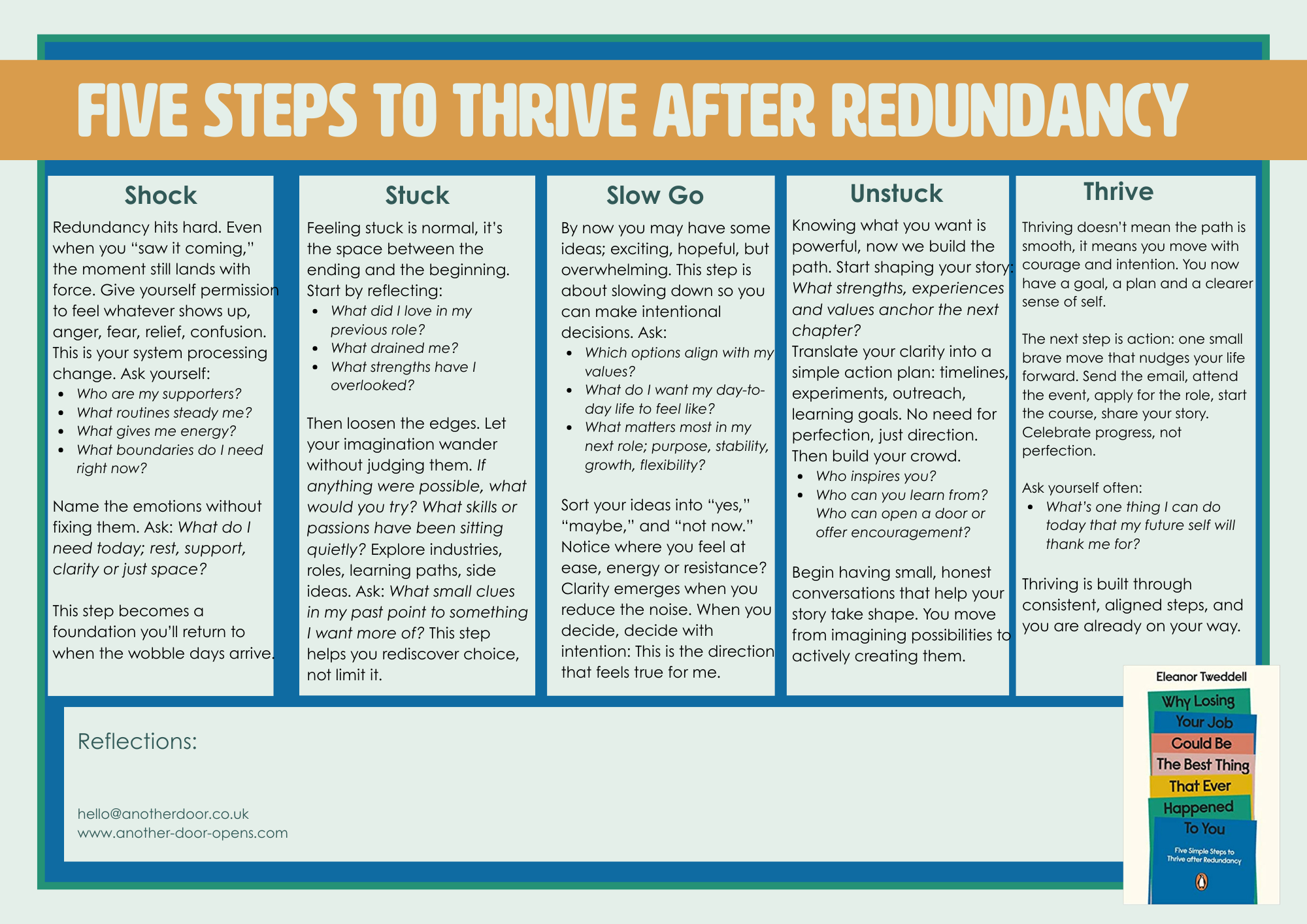
Redundancy is one of life’s sharpest, ouchiest (real word) curveballs. Even when the rumours circulate or logic tells us “it could happen,” the moment itself still lands with weight. It interrupts our routines, our identity, our sense of stability. But while redundancy is undeniably hard, it can also become a turning point, a moment to pause, reassess and rebuild with intention. This five-step framework is designed to guide you from shock to clarity, from stuckness to forward motion, and ultimately to thriving again.
STEP 1. EMBRACE THE SHOCK
When redundancy hits, the first instinct is often to push the feelings away and “power on.” But emotional honesty is the real starting point of recovery. Shock, anger, fear, embarrassment, even relief, all of these emotions are valid. Allowing yourself to feel them doesn’t mean you’re failing; it means you’re human.
This is the moment to build your personal resilience toolkit. What helps you steady yourself when life wobbles? It might be reconnecting with supportive people, establishing routines that ground you, or carving out quiet space for rest.
Ask yourself:
What do I need today?
What boundaries do I need to protect my wellbeing?
Who can I talk to that brings clarity rather than noise?
Acknowledging the shock rather than resisting it creates the mental and emotional foundation you’ll draw on throughout the journey ahead.
STEP 2. STUCK: REFLECT ON WHAT YOU WANT, ROAM FREE WITH IDEAS, RESET
After the shock settles, a new feeling often emerges: stuckness. You want to move forward, but the path feels foggy. This stage isn’t a problem (easy to say I know!), it’s a natural pause between the ending of one chapter and the creation of the next.
Start with gentle reflection. Consider what parts of your previous role energised you and which parts drained you.
Think back across your career:
When did I feel most like myself?
What do people consistently praise me for?
What strengths or interests have I sidelined?
Once you’ve reflected, allow yourself to roam freely through possibilities. Let your mind wander without judgement. What would you explore if anything were possible? A new industry? A different type of role? Freelancing? A project you’ve been ignoring for years?
Stuckness begins to soften when you allow curiosity to take the lead. As you reset, you may find that your next chapter is wider, richer and more possible than you first imagined.
STEP 3. SLOW GO: BEFORE YOU LEAP, SLOW DOWN, DECIDE, THEN GO
With reflection comes ideas, sometimes lots of them. The energy of possibility is exciting, but it can also feel overwhelming. Step three is all about slowing your thinking so you can separate the signal from the noise.
Clarify what really matters:
What do I want my next role to give me; growth, stability, freedom, purpose, challenge?
What kind of life do I want outside of work
How should my next step support that?
Sort your ideas into simple categories: “Yes,” “Maybe,” and “Not right now.” Often clarity shows up not through a dramatic revelation (ta dah!!) but through the revealing of what feels aligned.
Pay attention to your body as you think through options. Where do you feel energy or calm? Where do you tense up? These cues are often more honest than our thoughts. By the end of this stage, decision-making becomes simpler. You’ll know the direction that feels right, and you’ll feel more confident stepping into it.
STEP 4. UNSTUCK: CREATE A PLAN, A STORY & A crowd
Clarity is powerful, but clarity alone doesn’t create change, action does. This step turns insight into momentum.
First, shape your story. Redundancy isn’t the whole narrative; it’s a plot twist (like all the best thrillers!).
Think about:
What strengths, experiences and values do you want to highlight as you move forward?
How does your past set you up for your future?
Craft a version of your story that feels natural to share, hopeful and grounded.
Next, build a practical plan of action. Identify the steps you need to take, updating your CV, reaching out to contacts, exploring training, speaking to mentors, or testing your new direction with small experiments. These steps don’t need to be perfect or complex; they just need to move you forward.
Finally, build a supportive crowd. Surround yourself with people who lift you, challenge you, and open new doors. Your crowd might include former colleagues, industry peers, community groups, or new networks you join with intention. Progress accelerates when we’re supported.
STEP 5. THRIVE: IT MIGHT NOT BE EASY, BUT IT IS POSSIBLE
Thriving doesn’t mean everything is effortless. It means you move with courage, confidence and intention, even when the path is unfamiliar. You now have a goal, a direction and a plan. The next step is action.
Thriving is built on small brave moves: sending the email, applying for the role, attending the event, having the conversation, sharing your story, starting the project. Each move adds up, and each step reinforces the belief that your career is still yours to shape.
Thriving is also where you will be rejected, experience (many) setbacks, feel like giving up (alot). You’ll know you are trying because of these things.
Ask yourself daily:
What’s one thing I can do today that future me will be grateful for?
With consistency, resilience and a willingness to step outside your comfort zone, you will find your path again.
And not just survive but thrive.