
Leadership communications in times of uncertainty
Leading through uncertainty is not the same as leading through change. That feels like an obvious thing to write, but I’ve been thinking about this after running a workshop with some leaders.
The workshop was ‘Leadership communications in times of change’, but after conversations it was clear their business was full of uncertainty and disruption. There wasn’t a clear way ahead, or even a ‘burning platform’. There was an atmosphere of ‘holding pattern’ and ‘waiting’, trying to focus on delivering for customers in amongst unknown moving parts. So in those moments a very different type of leadership is needed.
Change, at least in the way we’ve traditionally framed it, assumes a destination. There’s a before and an after. A vision to articulate. A future state to describe in confident, energising language. That’s where much of the classic change literature sits, in rallying people towards something new.
But uncertainty doesn’t fit in those rules.
Uncertainty has no clear destination, yet. No guaranteed after if we want to be dramatic. And when everything feels like a burning platform - economic instability, political volatility, climate anxiety, technological acceleration, shouting “this is urgent” doesn’t mobilise people, it overwhelms them. And is highly confussing.
So a different approach is needed. And it might be a gear change from what we are used to.
Calm, not charisma
Leading through uncertainty isn’t about inspiring speeches or bold declarations. It’s about calm. Presence. Regulation, to use the word of the moment. It’s about that good old saying, “keep calm and carry on” but not as a slogan, but as a practice that can be felt.
When people don’t know what’s coming next, they don’t need (and cant get) reassurance that everything will be fine. They know you don’t know. Pretending and trying to maintain that face erodes trust faster than honesty ever could.
My view is leaders were (are) never really there to reassure. However in my work I see that people feel like its part of their managerial role. So has to be acknowledged, that what you think you are there to do changes in times of uncetainty.
The end of the all-knowing leader
One of the biggest leadership shifts required in uncertainty is letting go of the idea that you need to have the answers.
Instead, uncertainty asks leaders to be with people in the moment. To name what’s messy. To create spaces where immediate pressures and longer-term anxieties can sit side by side.
This is where messy conversations matter.
Not the polished town hall Q&A. Not the perfectly framed strategy deck. But the honest, slightly uncomfortable conversations where people can say:
“Here’s what’s worrying me right now.”
“Here’s what feels unclear.”
“Here’s what we can do right now, here’s where we can focus.”
Why messy conversations are the work
Uncertainty fragments attention. People oscillate between firefighting today and worrying about tomorrow. If leaders don’t make space for both, those anxieties leak out anyway, through distraction, rumours, resistance, or burnout.
Messy conversations aren’t about fixing everything. They’re about shared sense-making. About reducing isolation. About reminding people they’re not carrying this alone.
And crucially, they’re not one-off events. They’re ongoing, iterative, human.
I’m working on a workshop about how to have a messy conversation. It sounds straight forward, but it’s harder to carry out, especially if it needs you as teh leader to change your usual style. Trying to change as a leader and hold space for others is exhausting.
A simple framework for leading in uncertainty
In moments where clarity is scarce, even absent, structure still helps, not rigid plans, but light ‘scaffolding’ for conversation and action. Here’s a simple framework (of course based on the 5 steps!) for those messy moments:
Pause
Before reacting, pause. Slow the moment down.
What’s happening right now?
What do we need?
A pause creates space to think rather than default.
Mess
Name the reality and acknowledge the unknowns (without having answers).
Where are emotions?
Where are priotiries and focus?
No spin. No answers. No forced optimism.
Play
Explore possibilities without commitment.
What are our options?
What might help?
This is not decision-making yet, it’s sense-making and feeding the urge to find solutions.
Try
Uncertainty favours small moves or we can experiment with, without huge risk.
What small steps can we try?
What could make a difference right now?
Trying things with an air of experimenting helps to move forward without big commitment.
Restart
Re-anchoring and being clear on boundaries, immediate priorities and things we can do help people to keep moving.
What is within our control right now?
What do we commit to until the next check-in?
Focus on what we do control in moments of uncertainty and taking ownership restores agency.
You may cycle throughthis check-in weekly, daily, monthly - depending on what is happening.
From certainty to steadiness
Leading through uncertainty is less about strong visionary direction and more about steadiness. Less about answers and more about holding space.
It requires leaders to regulate themselves first, to tolerate ambiguity, resist the urge to over-promise and find answers, and stay present when there is no obvious way forward.
No one knows exactly what the future holds. Saying that out loud isn’t weakness, it’s reality. And in uncertain times, reality handled well is far more stabilising than false hope ever was.
Leadership hasn’t become impossible, it’s just become more messy human.
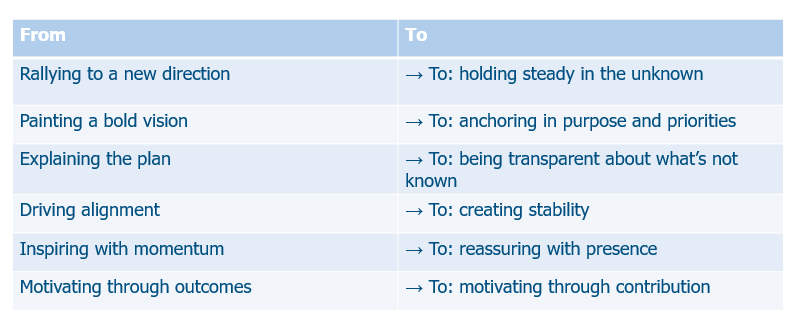
Conversation Prompt Card: Leadership communications in times of uncertainty
Example of Change v Uncertainty. We used this as a prompt for conversation in the Leadership Change Communications workshop. Where change used to be routed, and where we are moving towards. And then a conversation about what that means, how you’ll get there.
If you are interested in hearing more about Leading Change / Communication workshops drop a note to hello@anotherdoor.co.uk