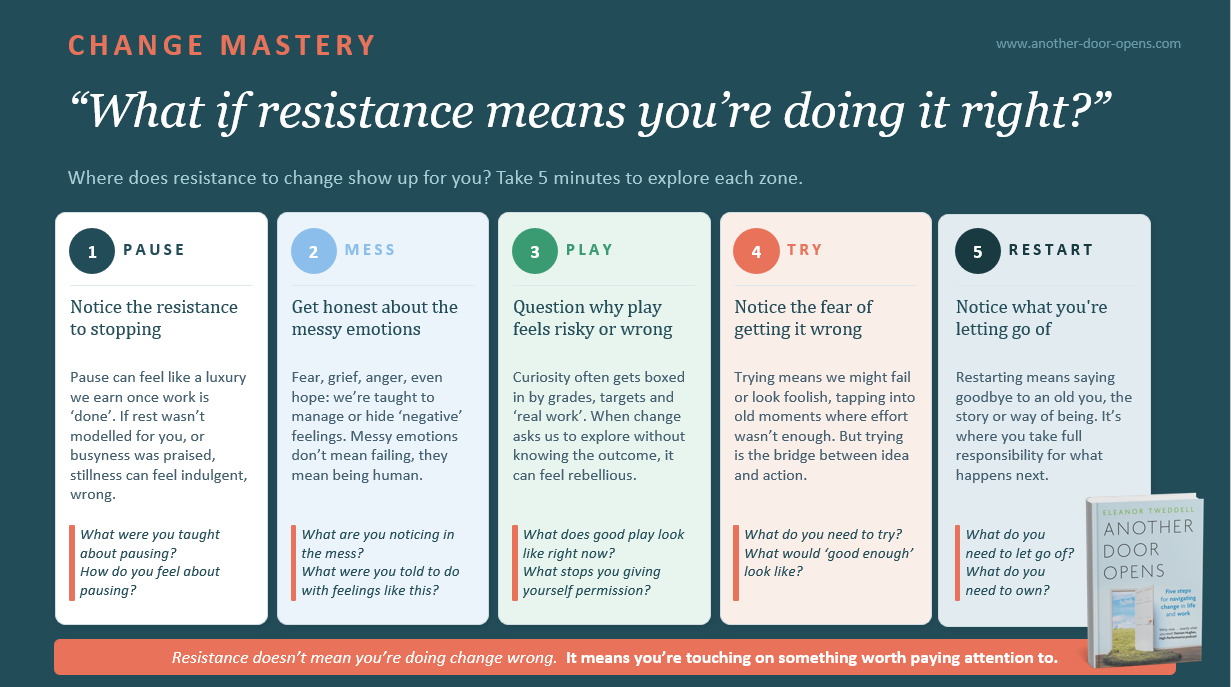
The five zones of navigating change -And why each one feels so hard, resistance is real!
Change isn’t a straight line. It’s not a five-step plan (yes I know, the irony!) or a project timeline, or falls in sequence. It’s a lived, human experience and like all things human, it’s messy, non-linear, and often full of contradictions.
There are five zones, as featured in the book Another Door Opens, that we move through in times of change: pausing, messy emotions, playing, trying, and restarting. Not always in that order. Not always lined up. But they show up in moments of change. And once we know about them it can help us navigate any change that comes our way.
This comes with a ‘warning’ or ‘watch out’ - each of these zones carries its own kind of resistance. Not because we’re doing change wrong (because sometimes that’s how it feels), but because we’ve been taught, in subtle and not-so-subtle ways, to mistrust, or question, the very things that help us move through it.
Let’s explore more…
Here are the five steps, and the challenges each might bring for us in the form of resistance.
But sit with your own feelings and thoughts on what each step brings to you.
1. Pause
Pause is often viewed on as a luxury. Something you get to do after the work is done (if it ever gets ‘done’). Not something you choose in the middle of the work, or worse of all, before you’ve even begun.
Pausing can feel unproductive. Self-indulgent. Lazy, even. And for many of us, that message runs deep. Maybe you grew up in a home where rest wasn’t modelled. Maybe you were praised for keeping busy, staying ahead, not making a fuss.
But in change, pausing is essential. It’s the breath before the move. The stillness where we can hear ourselves think. It’s where we feel the disorientation, the pull to do something, and we choose, just for a moment, not to.
And that can feel deeply uncomfortable. Because everything in us wants to move. Fix. Prove. But pausing is where we begin to notice what’s actually going on and that noticing is the doorway to real change.
Ask yourself: How do you feel about pausing?
2. Mess
Ah yes. The bit we all try to skip, because, well, it’s messy.
Fear. Grief. Anger. Confusion. Even hope. These emotions aren’t comfortable to acknowledge. And they leak all over the place. At work they don’t fit neatly into a communications plan or a leadership update. Perhaps we’ve been taught, from childhood, that “negative” emotions are something to manage, minimise or get over.
“Calm down.”
“Don’t cry.”
“Be brave.”
“Stay positive.”
But change brings loss. Even good change. And loss brings emotion. When we bypass that, we bypass the truth of the experience.
Messy emotions don’t mean we’re falling apart, they mean we’re human. And if we want people to move through change in a way that honours dignity and wholeness, and be open to opportunity, we have to make space for the mess.
Change is not smooth, simple, and straightforward. We need time to process, often more time than we think. And it comes in waves, with turbulent timelines. We need support to understand what's happening and to begin imagining what comes next. And even with the best intentions and planning, things go wrong. Because change comes with uncertainty, and with uncertainty comes the unknown. It’s messy.
And yet, when we feel overwhelmed or emotional in the midst of it all, we often assume we’re doing it wrong. I shouldn’t feel like this, I can’t feel like this, we tell ourselves. We think that feeling confused is a sign of failure, when really, it’s just a sign that we’re human.
So what if we normalised the mess? What if we accepted that in the middle of a wave of change, our emotions, even the big, messy, conflicting ones, are not only expected, but completely valid?
Because they are. And acknowledging that might be the most powerful step we take in navigating change well.
Ask yourself: What are you noticing when you think about your messy emotions?
3. Play
Play is powerful and where the magic happens, and yet it can be seen as a frivolous action. It’s how we learn, imagine, experiment and connect. But somewhere along the way, many of us internalised the idea that play is only for children or worse, that it’s a distraction.
Maybe you were told off for “messing around, playing around.” Maybe your curiosity got labelled as disruptive, “stop questioning everything”. Maybe your creativity was boxed in by tests, grades, or expectations of what “real work” looks like.
So when change asks us to play - to stay open, to imagine other ways, to explore without knowing the outcome, it can feel risky, rebellious. Even dangerous.
But play is where possibility lives. And where we can solve problems. It’s where we loosen our grip on the old way, and start to sense what could be next. And when it’s safe enough to play, even just a little, something new can start to emerge. An idea, a reinvention, a fresh perspective, energy to help keep you moving.
Ask yourself: What does good play look like to me right now?
4. Try
Trying might sound simple, right? Just… have a go. Get on with it. But trying is where a lot of us fall. Because trying comes with a lot of baggage.
Trying means we might get it wrong. We might look foolish. We might fail. And that taps straight into every childhood or past moment where effort wasn’t enough, or where the stakes of getting it “right” were too high. Or where we learnt how not to make ‘mistakes’.
For many of us, trying became something we only did if we were sure we could succeed. But in moments of change there is no way of guaranteeing ‘success’ unless we question what trying looks like, and therefore what success looks like.
In change, trying is the bridge between idea and action. It’s imperfect. Vulnerable. Courageous. And it’s often the only way we learn what can actually be real, and what will remain a fantasy.
Trying is where we test the water. Take the small step. Say, “I don’t know if this will work, but let’s see.” And in that act, we begin to move not because we’re super confident, but because we’re willing to try. To back ourselves in the moment of trying.
Ask yourself: What do you need to try?
5. Restart
You’d think starting would be the easy part. It’s full of energy, hope, and fresh beginnings. But starting, or restarting as I’ve labelled it can often feel out of reach. And I say ‘restart’ because it’s not about continuing to muddle through. The restart zone is about the moment you draw a line, take all the learnings, take ownership and focus on who you now want to be, how you show up, how you manage your time, behaviour, attention.
Restarting means letting go of old you, intentionally.
To start something new, we have to say goodbye to something else. A role, a story, a way of being. Even if the old way wasn’t working, it was known. And the new way? It’s not. It’s easy to keep doing what you’ve always done and hoping it all works out. But the point of this is to make change a good thing. So you have to up your game on take responsibility and doing the hard work which turns change into opportunity. And it can be hard. Its easier just to slip into your default and take the easy, but maybe less rewarding route.
That’s why restarting often comes with a tangle of feelings, excitement, yes, but also doubt, fear, grief. It’s not a clean break. It’s a slow, creaky door. With many challenges to navigate, but because you’ve worked through the other 4 zones, you knwo why this is important to you, and why you are doing this restart.
Restarting is where we reclaim agency. It’s where we say: I’m here. I’m in. I’m willing to walk forward, even if I don’t know the whole map.
Ask yourself: What do you need to do to restart with intention?
So where are you right now?
Maybe you’re pausing. Maybe you’re swimming in messy emotions. Maybe you’re trying to remember how to play.
Wherever you are, know that “resistance doesn’t mean you’re doing it wrong. It means you’re touching something interesting, exciting even, that possibilities are emerging”.
Something that’s been shaped by years of messages about who you’re meant to be, and how you’re meant to do it. The invitation isn’t to push through, muddle through, or survive. It’s to notice what you’ve been taught and to ask if it still serves you.
Because real change doesn’t just happen around us. It happens in us.
And that’s the work.