You're too busy to stop and think, but that's the problem.
I’m playing with the idea we get caught in the busyness loop, and it just spins and spins, and wears us out but we cant stop because the loop is keeping us looping. If we stop the loop, then who are we? everything will fall? everything will fail? Or will it?
"How are you?"
"Busy."
We say it so automatically we barely notice it. Busy is the default answer, the social shorthand, the badge we wear to signal that we are useful, needed, in demand, earned our place on this planet.
Except. Does it?
What even is busyness?
Here's a question worth sitting with: where is the pressure / motivation / energy actually coming from?
Some of it is real. Genuine demands, genuine deadlines, genuine people who need things from you. But also some of it?Some of it is cultural programming so deep we don't even question it.
Research from Columbia University found that busyness, in some parts of the world, has replaced leisure as the ultimate status symbol, the busier you appear, the more competent and in demand you seem and feel. We have created a world where running on empty reads as success.
Studies show that busyness is now perceived as a signal of higher social status, while leisure can be interpreted as a lack of ambition or relevance. So we perform busy. We wear it, bond over it, compete with it. Judge with it.
Tricia Hersey, author of Rest is Resistance, calls this grind culture, “the oppressive grip of a system that has convinced us our worth is tied to our output.” Her argument feels radical: rest isn't a luxury but an absolute necessity, not a reward you earn after you've finished everything on the list, or even the last resort when you can do no more, but a human right.
And yet, quite often after my Change Mastery workshops a question repeatedly comes up: “this all sounds good but Im too busy to do this”.
This always intrigues me. As the point of the thinking framework I share is to make change easy. And to start to change you have to coniously make space to think and decide - and go through the 5 steps. My work has been designed to make it easy. But I can not force you to make the first move. Somehow you have to find that first move yourself. So Ive done some exploring to help people stuck in the busyness loop make a first move.
Because only you can decide: how I’m working / living is fine with me, it’s how I want to work / live - or how I’m workig / living is not fine, I want to find another way. That is the choice you sit with. Noone can force you to change.
So when someone tells me they're too busy to pause, I wonder if something else is driving that thought deep down, like: I've been told that stopping is dangerous. That slowing down means falling behind. That thinking is less valuable than doing.
Maybe we are addicted to doing. And like all addictions it’s going to take work, and attention to help you change that.
The science of too much pressure
There's a psychological principle called the Yerkes-Dodson Law, first described in 1908. It shows that performance improves with arousal but only up to a point. After that, it declines. The relationship is an inverted U-curve: too little pressure and you're disengaged; too much and your performance deteriorates.
In practice that means too much stress causes worry, overthinking, and poor performance. The relentless busyness you're defending as productive? It may actually be pushing you past your peak and quietly degrading the quality of your thinking, your decisions, your work. You are not operating at full capacity. You are operating in survival mode and calling it success.
Chronic busyness creates a kind of low-grade ongoing stress response, a constant mild fight-or-flight state with real consequences for health and mental wellbeing. In that state, we don't think well. We react. We repeat. We mistake movement for progress.
See other articles > https://anotherdoor.co.uk/another-door-blog/2026/6/4/what-do-you-really-need-right-now-the-six-energy-elements-that-will-help-you-to-move-through-change-better
Procrastination, laziness and the story we tell ourselves
Maybe this is the uncomfortable one, the reason many of us don't stop and think isn't because we're too busy. It's because we're avoiding it. It’s convenient being busy, isn’t it?
Katy Milkman, author of How to Change, has spent her career studying why we don't do the things we know are good for us. Procrastination for example, is such a barrier to change because of present bias, we value the rewards we can get right now above the rewards we'll achieve in the long run. Stopping to think doesn't deliver an instant reward. It's slow, sometimes uncomfortable, occasionally confronting, even frustrating. So we fill the space instead with action, with busyness, with the satisfying tick of clearing a to-do list, even if we didnt really need to do that thing on the list.
"The thing that first caught my attention was this idea of present bias: the tendency to care much more about what we'll get right now, and dramatically underweight the long-term consequences of our decisions. That resonated with me immediately as explaining my own procrastination and bad decisions throughout life."
— Katy Milkman, How to Change
Katy identifies laziness and procrastination as two of the key internal forces that prevent us from changing, not laziness in the traditional sense, but a structural tendency to favour what's easier right now over what's better in the long run.
Because busy can be a form of lazy. When we're heads down, ticking boxes, running from meeting to meeting, we're not really thinking. We're reacting. We're doing what we've always done, the way we've always done it, because there's no space to do anything else. We’re getting through the day. Surviving. And maybe tipping away from being ‘optimal’ (whatever that looks like for you) and towards burn out / exhaustion.
What would happen if you took one hour?
Not a week away. Or a year exploring yourself in Thailand. Not a digital detox retreat. One hour. Just one, genuinely protected, to think.
Sometimes we're on autopilot because autopilot gets us through the day. But what is actually filling your time right now? What are you prioritising and who decided that? What is the drive and pressure you're feeling, and where is it really coming from?
This is what the five steps are for, not just for big life moments, but for this. Right now.
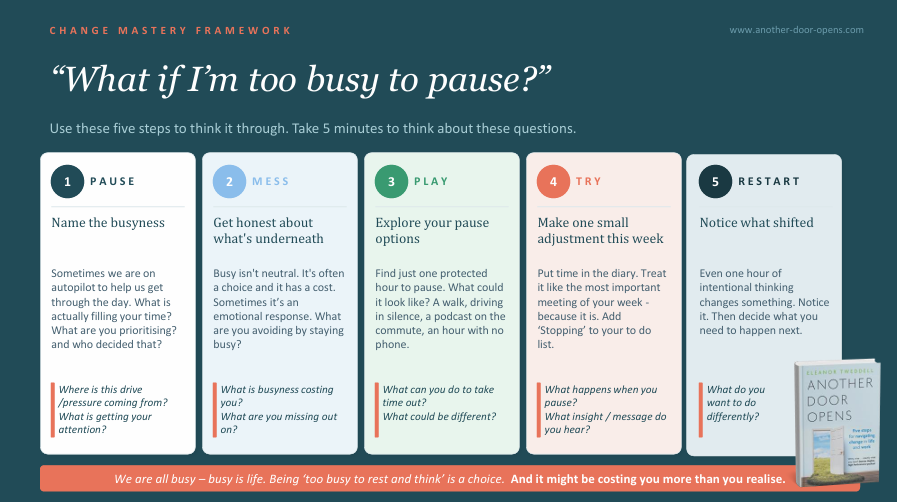
Have a play with the 5 steps to see how you can make time to think, despite the busyness you are feeling:
Pause: Name the busyness honestly. What are you prioritising and who decided that? Where is this pressure coming from? What is getting your attention?
Mess: Get honest about what's underneath it. Busy isn't neutral, it's often an emotional response. What are you avoiding by staying busy? What is busyness costing you? What are you missing out on?
Play: Explore your pause options. Find just one protected hour. What could it look like? A walk, driving in silence, a podcast-free commute, an hour with no phone. What can you do to take time out? What could be different?
Try: Make one small adjustment this week. Put it in the diary. Treat it like the most important meeting of the week, because it is. Add 'Stopping' to your to-do list. What happens when you pause?
Restart: Notice what shifted. What insight or message did you hear? Even one hour of intentional thinking changes something. Then decide what you want to do differently, and what needs to happen next.
Letting go to make space for new
Sometimes we have to let go of our comfort zone, our default, the way we’ve always got by - when we let go, it’s not about knowing what replaces it, if anything. Letting go is creating space for a new way of thinking. And that includes not feeling at the mercy of your to do list. Let go of thinking the way youve always done it is the best, to make space for possibility that there maybe a better way, a way that makes you feel better.
So what do you need to let go of?
We are all busy. Busy is life. But being too busy to rest and think is a choice and it might be costing you more than you realise.
You will not reach the end of a very full day, week, month, year and think: My busyness has served me well.
Busyness is not a measure of your worth, your ambition, or your value. And in a world that has spent decades convincing you otherwise, pausing to think,really think, might be the most productive, most courageous, most quietly radical thing you do all week.
You’ll thank yourself later.