Change has a peculiar way of keeping us busy. We rush to fix, fill, and figure things out, often without stopping to ask ourselves the most important question: what do I actually need right now?
This is where the Strategic Pause comes in. Not a pause as in doing nothing (though that's sometimes exactly right), but a deliberate, intentional moment of checking in with yourself. And in my Change Mastery workshops, this is one of the most powerful things we do, because the answer is almost never what people expect. And once you know about the Strategic Pause (and the six energy elements) it will help you through all kinds of life’s moments.
The problem with pushing through
Back in 1908, psychologists Robert Yerkes and John Dodson mapped out something that is still very relevant today. Their research showed that performance improves with mental arousal up to an optimal point but beyond that point, too much arousal causes performance to drop. Too little stimulation and you're disengaged and flat; too much and you're overwhelmed, making mistakes, or running on empty. So we need to be fine tuning how we navigate these two states.
Change, by its very nature, tends to push us towards the edges of that curve. We either go into overdrive, more doing, more planning, more reacting or we stall out entirely, too exhausted to move. Either way, we miss the sweet spot. The Strategic Pause is how you find your way back to it.
Wellness, rest, and what we actually need
We've long known that wellbeing isn't one-dimensional. Back in the 1970s, Dr Bill Hettler, co-founder of the National Wellness Institute, developed his Six Dimensions of Wellness model: physical, intellectual, emotional, social, spiritual, and occupational. He states that all six must be present for a person to attain overall wellness. It was a quietly radical idea: that you couldn't just fix one thing and call yourself well. I guess it depends what we think ‘fixing’ is. This model is still used to think about wellness, and whole wellness and growth.
Dr Saundra Dalton-Smith takes this further in her book Sacred Rest. Her argument is that rest isn't simply the cessation of activity, it's about restoring the specific type of energy you've depleted, in work and play. So even fun isn't necessarily ‘restful’. She identifies seven types of rest: physical, mental, spiritual, emotional, sensory, social, and creative and explains that a deficiency in any one of them can affect your health, happiness, relationships, and productivity. It’s a great book to change your relationship with how you see rest.
Both frameworks point out that it is not a single dial that needs turning up or down. We are a whole system and in moments of change, different parts of that system need different things. So I expanded on this idea and mapped out what kinds of ‘energy’ - whether restful or stimulating we really need as we navigate change. Because how we see things, feel things, do things might have changed.
In the Change Mastery workshop, exploring the Six Energy Elements is without doubt one of the most game changing moments for people.
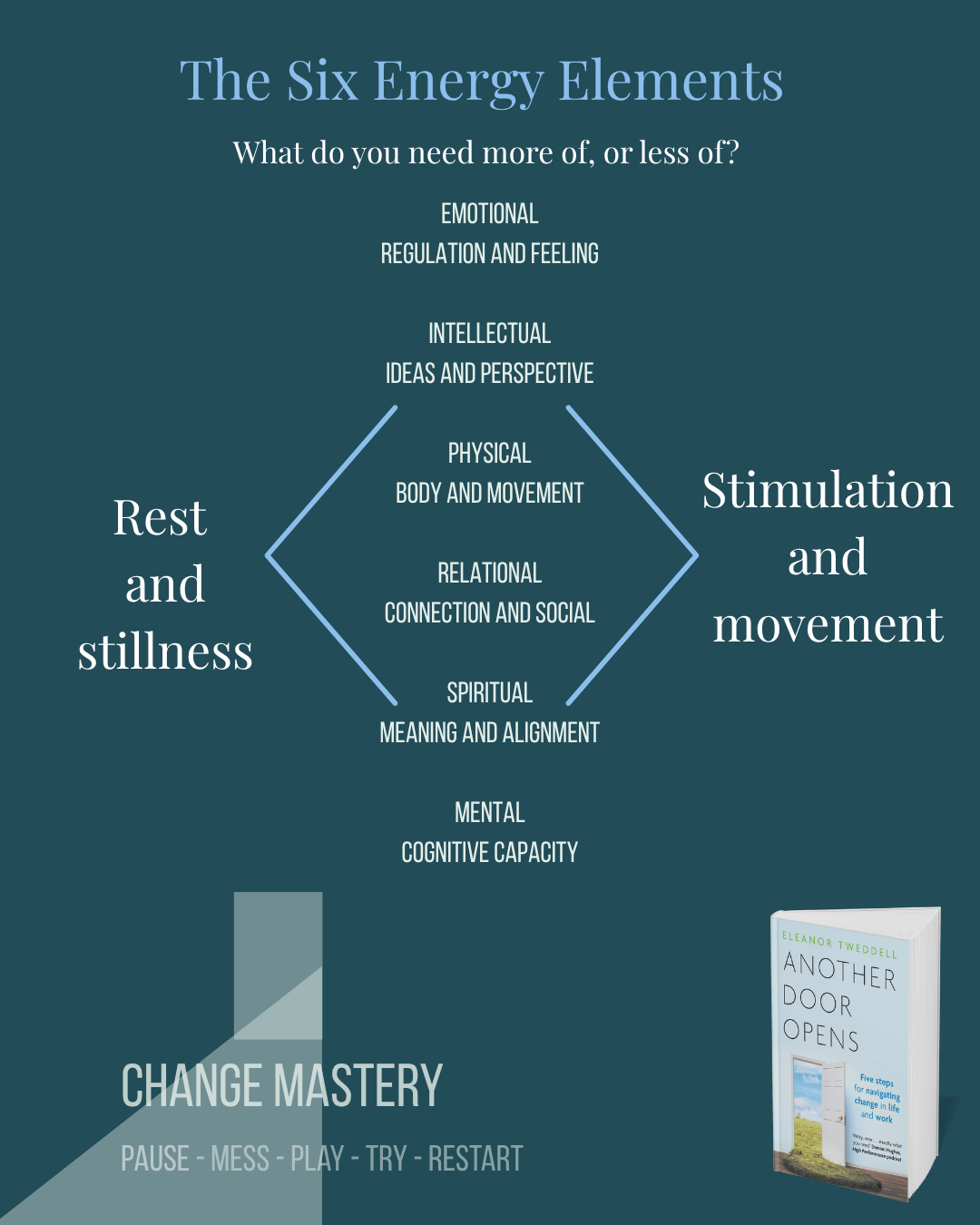
The six energy elements
The Six Energy Elements are specifically designed for moments of transition, when the question isn't just "am I well?" but "what do I need right now?" Each element sits on a spectrum between Rest and Stimulation. Sometimes you need more. Sometimes less.
Here's how each element can show up, but also keep an open mind, as this is to prompt your thinking - not be a complete answer.
Emotional (Regulation and feeling) Swinging between overwhelmed and numb? If your emotions are bottled up, you might need more - expression, connection, permission to feel it properly. If you're saturated and running on fumes, you need less - quieter spaces, safety, the compassion to not have to perform okayness for anyone else.
Intellectual (Ideas and perspective) Stuck in repetitive thinking, or even feeling bored? You might need more - challenging conversations, a new perspective, something to get your cogs turning. But if your head is already spinning, the answer is less - fewer inputs, a mindless pause, some that doesn’t need attention.
Physical (Body and movement) This is the one we most often get backwards. Feeling sluggish and heavy? It might not be rest you need, it might be more movement, getting out of your head and into your body. But genuinely depleted? Then less is right - real recovery, nourishment, sleep, no guilt required.
Relational (Connection and social) Change can simultaneously make us crave connection and desperately need space. The trick is knowing which is true right now. Feeling socially drained? Less - solitude, boundaries, quiet. Feeling isolated in it all? More - dialogue, community, the simple comfort of people who don't need you to have it figured out.
Spiritual (Meaning and alignment) When change leaves us feeling directionless or cut off from what matters, it's often a signal that our sense of meaning needs attention. Sometimes more is what's needed - reconnecting with values, with purpose, with what you're actually doing this for. Sometimes less - letting go of expectations, releasing the pressure to have a grand answer, and allowing for stillness.
Mental (Cognitive capacity) Mind in overload? Less - Fewer decisions, simplification, mental quiet. Bored and under-stimulated, going stale? More - A gentle challenge, some reframing, a stretch in a new direction.
Sitting with the question
In the Change Mastery workshop, we use the Six Energy Elements not to optimise yourself, we are in the Pause zone - it's to notice what's actually going on, without judgement. And recognise what you really need right now.
Because in moments of change, most of us are running on strategies that worked for a version of our life that no longer exists. The Strategic Pause asks you to put that aside and ask something simpler and far more useful: what do I need more of right now, and what do I need less of?
Sometimes the answer is obvious the moment you stop and ask it. Sometimes it surprises you completely. Both of those things are useful.
That's why we need to pause.
That’s why we can’t afford to dismiss pause because we are too busy. We have to understand what we really need otherwise we’ll be continually feeling the turbulence as we navigate change.
Explore the Six Energy Elements in the Change Mastery workshop - a practical, reflective space for navigating change well.