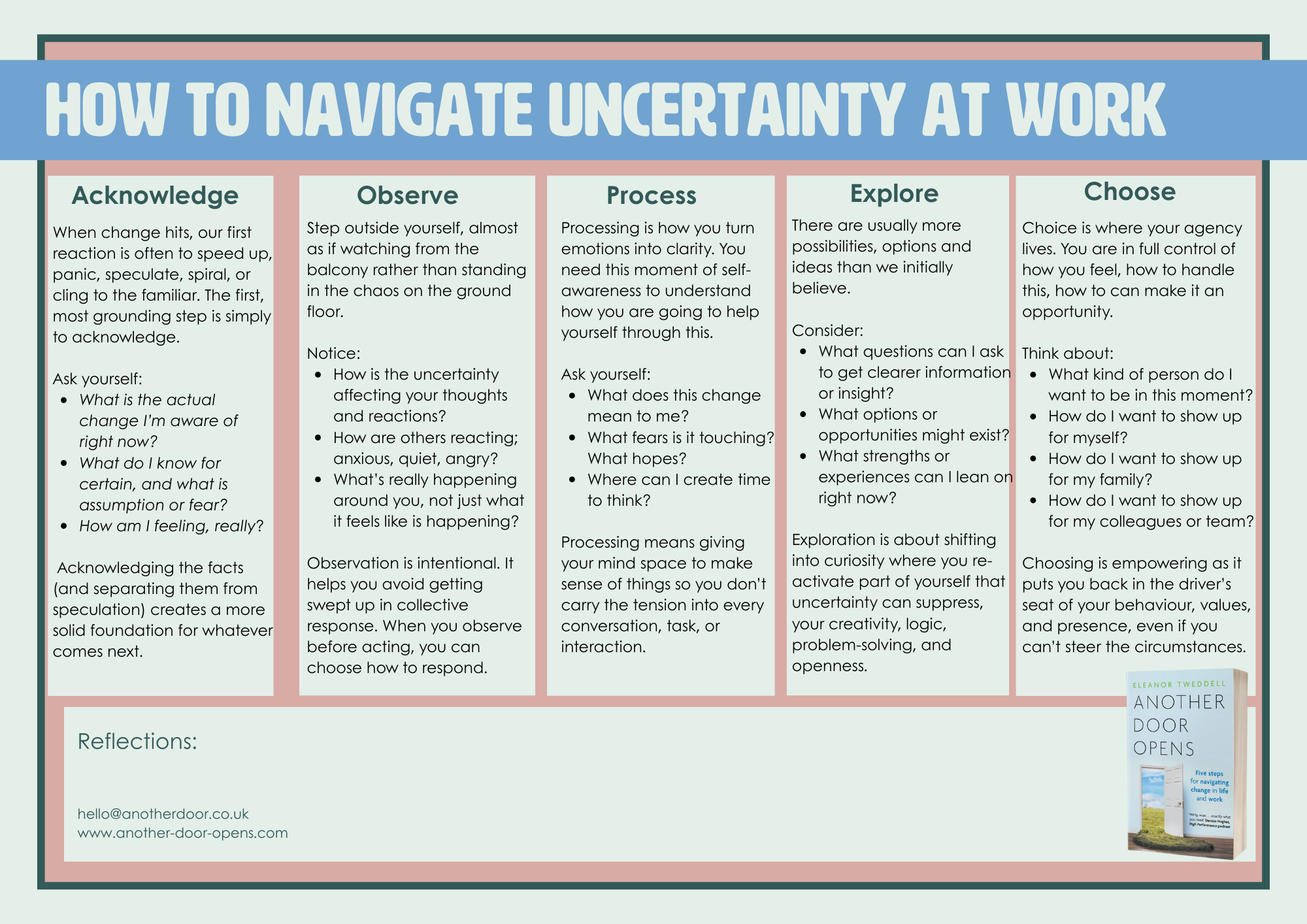
Navigating uncertainty at work in that ‘Change Holding Pattern’
Change can come slowly and then suddenly, an (expected) announcement, a (rumoured) restructure, a (much talked about) takeover, and then you are in suspense as redundancy consultations that aren’t yet confirmed but loom in the air. It creates a space of liminality: that uncomfortable in-between where nothing is clear, emotions run high, and our minds race faster than facts can keep up.
Enter into the Change Holding Pattern
The holding pattern of organisational change is that uncomfortable phase where employees must continue delivering business-as-usual work while waiting for decisions, consultations, or restructures to unfold. You’re moving, but not progressing; responsible, but not informed. It’s a suspended state that creates emotional strain because the future feels paused, yet the workload doesn’t.
In these moments we can feel worried, angry, frustrated, even powerless. But if we can take a small breath, we create the possibility of responding rather than reacting. Even in uncertainty, there is room for agency, perspective, and choice. And the way we navigate these moments doesn’t just affect us; it ripples outward to colleagues, teams, and even our families.
Here are five steps that help you move through immediate, unplanned change in that moment it arrives at your doorstep.
1. Acknowledge: Name What’s Happening and How You Feel
When change hits suddenly, our first reaction is often to speed up, panic, grasp for information, speculate, spiral, or cling to the familiar. But the first, most grounding step is simply to acknowledge.
Ask yourself:
What is the actual change I’m aware of right now?
What do I know for certain, and what is assumption or fear?
How am I feeling, really?
You don’t need to judge your emotions or tidy them up. They might be messy, conflicting, even overwhelming. That’s normal. Naming them helps regain a sense of stability. Acknowledging the facts (and separating them from speculation) creates a more solid foundation for whatever comes next.
2. Observe: Step out and notice Without Judgement
Once you’ve acknowledged the situation, shift into observation mode. This means stepping slightly outside yourself, almost as if watching from the balcony rather than standing in the chaos on the ground floor.
Notice:
How the uncertainty is affecting your thoughts and reactions
How others are responding, are they anxious, quiet, angry, hyper-productive?
What’s actually happening around you, not just what it feels like is happening?
Observation isn’t passive. It’s intentional. It helps you avoid getting swept up in collective panic or the emotional contagion that often follows organisational change. When you observe before acting, you buy yourself time to choose a more grounded, thoughtful response. You can help yourself stay out of stress, and be ready to see opportunities.
3. Process: Create Space to Think and Feel
Processing is the step most people skip because it requires slowing down in a moment that feels like it demands speed. But processing is essential, it’s how you turn raw emotion and scattered information into clarity. You need this moment of self-awareness to understand how you are going to help yourself through this.
Ask yourself:
What does this change mean to me personally and professionally?
What fears is it touching? What hopes?
Where can I create time (an hour, a walk, on the commute, a journaling session) to think without interruption?
Processing doesn’t mean overthinking. It means giving your mind space to make sense of things so you don’t carry the tension into every conversation, task, or interaction. It helps you disentangle what you can control from what you can’t. It means you’ll be more likely to get what you want from this moment, as you can operate with calm intention.
4. Explore: Look for Options, Possibilities, and Questions
Once you’ve processed your initial emotions and sense-making, you’re ready to explore. Even in moments that feel restrictive, there are usually more possibilities than we initially believe.
Consider:
What questions can I ask to get clearer information or insight?
What options or opportunities might exist, internally or externally?
What strengths or experiences can I lean on right now?
Exploration isn’t about making decisions yet. It’s about widening the frame. Often, just by shifting into curiosity, you re-activate part of yourself that uncertainty can suppress, your creativity, logic, problem-solving, and openness.
5. Choose: Decide How You Intentionally Want to Show Up
Ultimately, uncertainty won’t always disappear immediately but you can still choose how you show up within it. Choice is where your agency lives. You are in full control of how you feel, how to handle this, how to can make it an opportunity.
Think about:
What kind of person do I want to be in this moment?
How do I want to show up for myself, first and foremost?
How do I want to show up for my family, who may feel the ripple effects of my stress?
How do I want to show up for my colleagues or team, who may be struggling too?
Choosing is empowering because it puts you back in the driver’s seat of your behaviour, values, and presence, even if you can’t steer the circumstances.
You Can’t Stop Change, But You Can Influence Your Experience
Change, especially unexpected, unsettling, or ambiguous change, is hard and unerving. No one navigates it perfectly. But by acknowledging what’s happening, observing more than reacting, processing with intention, exploring options, and choosing how to show up, you create stability within instability.
The change, the person telling you about the change, the stuff happening around you are not making you feel crap, you are letting yourself feel crap as a reaction to the things happening. You have a lot more agency in this moment of change and uncertainty than you might think.
These steps don’t make uncertainty disappear. They help you hold your ground within it and your steadiness may become a ripple of steadiness for others too. The steps will help you create space so that you don’t miss opportunities, you keep yourself well, you are still in ownership of how you feel and respond.