
Most of us have heard of fight or flight. It’s one of those phrases that has made its way from the psychology textbooks into everyday conversation (well depends on who you are talking to I guess!). The kind of thing people say when they’re explaining why they snapped at someone in a meeting, or why they suddenly found themselves power-walking away from an awkward conversation at a party. Yes, ok, I’m exposing that I hang around with some odd friends sometimes! But… hang in there with me…
I shared some thoughts about it on LinkedIn recently. And LinkedIn did it’s magic, like it sometimes does. And suddenly had an intriguing topic for a ponder. We might just know the fight or flight phrases, but now we are up to six responses when you start looking into it. If you’ve read my book (Another Door Opens) you’ll know I love a good rabbit hole. Where you get deep curiosity for something, and disappear trying to find out more. So here goes what I found out…
A quick side note observation that I couldn’t let go of; they do all start with F. This is entirely deliberate, apparently, the alliteration makes the framework memorable and easy to recall under pressure, which is exactly when you need it. Although if you wanted to simplify it to make it even more memorable “Fight, Flight, or Something Else” might work better, and well, that would be FFS. Which, honestly, is also a fairly accurate summary of how most of us feel in a stress response. Anyway…
In the beginning
The fight-or-flight response has been with us since the beginning of time ( it obviously wasn’t named in the beginning of time but it was what we were doing). Originally described by physiologist Walter Cannon in the 1930s. He was studying how animals reacted to threat, observing that the body released a surge of hormones to prepare for immediate action, to confront or escape.
There’s a catch though, as Kathryn Kneller pointed out on my LinkedIn post. All of the research was conducted almost exclusively on male subjects. And, apparently, not for a great reason. Female hormones, especially those involved in the menstrual cycle, were considered too complicated and “disruptive” to the consistency of the data. In short, women were often excluded from stress research because their biology was seen as inconvenient. Don’t quote me, could just be gossip, but I’ve read it in a few articles now.
Breathe ladies, and male and other allies, breathe.
And then Freeze joins the picture
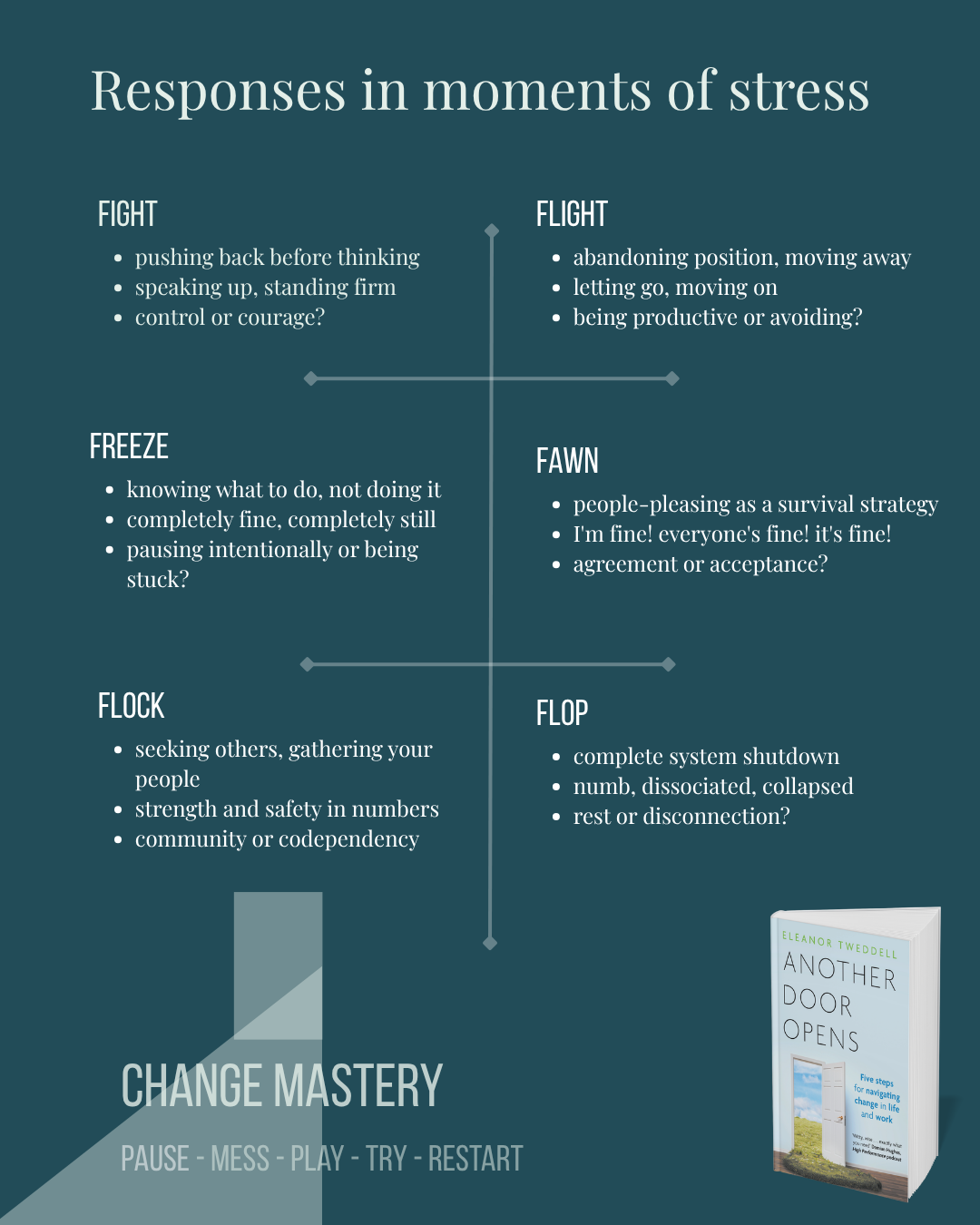
Freeze was added as researchers noticed what the binary fight flight model missed: sometimes people do neither. They go still. They can’t decide. They zone out. They crap themselves. The freeze response kicks in when stress leaves you feeling paralysed. You might zone out, feel numb, or become unable to decide. In extreme danger, freezing can actually be protective. In everyday life, a difficult conversation, a looming decision, a restructure at work, it tends to feel like being stuck in wet concrete. But freeze can be a good thing. It can be a pause we need. To suss things out, observe, think, process. So freeze gets a bad rep, but sometimes we freeze for a very good reason.
But then a rethink… Fawning was identified
In 2000, Shelley Taylor, a UCLA psychologist, put forward a theory of stress response she called “tend and befriend”, this was the origin of what is often, now, call “fawn or fawning.” Shelley noticed that the existing research didn’t capture how many people, particularly women, responded to stress by moving towards others rather than against or away from them. But not just the act of gathering, fawning is more like how we are interacting with others in these moments.
Shelley’s work helped correct that imbalance of research base (which has been quoted at only 17% female before her work) and her findings were: under stress, we may seek connection, try to smooth things over, or work hard to keep the peace.
The fawn response, people-pleasing as a survival strategy, will be familiar to anyone who’s ever found themselves agreeing to something they didn’t want to do, just to make the tension go away. Sometimes, like all these responses, it’s a good thing - we might need the peace keeper, it might be a calming voice. But we also must be aware of how it serves us.
Flock and flop: the newest arrivals
Flock is the response that reaches outward, not to appease, but to gather. It feels like fawning as the orginator, but it’s not to please, it’s get connection, to gather around, a rallying response. To make a group WhatsApp at 11pm because something has happened and you need your people, kind of vibe. Both people and animals who find themselves in danger may seek safety by flocking together, gaining strength or solace through numbers and social cohesion. It’s still emerging as a recognised response and different researchers frame it differently. There were a few versions of what it is and how it shows up. But it reflects something real and what we see, and maybe what we, ourselves have done, about how we instinctively move towards community when things get hard. I’m thinking the morning coffees and cakes at the local cafe when we’d all been made redundant. I guess we were flocking (and clocking).
And then there’s flop! Unlike freeze, which feels tense and alert, maybe purposeful, flop involves a drop in energy, muscle tone, and presence, a dissociative state, the nervous system’s last-ditch survival strategy, the shutdown button. On Save-Battery mode. It can look like emotional numbness, complete exhaustion, or collapsing, folding, inward when everything becomes too much. Where freeze is stuck, flop is gone, nothing left in the tank. Some of the articles talked about burnout and depression at this stage.
So, does this mean fawn and flock are “female” responses and fight and flight are “male”? No, and it’s worth being clear about that. That’s not what is being said. Behaviour, including fighting or fleeing, or freezing or fawning, is not binary, male or female. What the research does suggest is that the original model was built on a narrow slice of human experience, and the picture has rightly expanded.
So now what do we do with knowledge
It’s tempting to treat these six responses as a ranking, sequenced thing, fight and flight at the top (decisive! active!), with freeze, fawn, flock, and flop somewhere below (passive, avoidant, needy). But that’s not how they work. And although that was my first thoughts, it really isnt how we respond when we think about it.
Each response has its place and purpose. Fighting back can be exactly right when you need to assert yourself or hold a position. Flight - leaving, letting go, moving on , can be genuinely the wisest move. Freeze creates space before you do something you’ll regret. Fawn might bring the peace you need right now, even if it sometimes goes too far. Flock can be about reaching for your people, gathering, in a crisis is one of the most human things there is. And flop is the body saying, with great authority: enough.
The more useful question is, how am I responding, what is this response telling me? Your stress responses are data. They reveal what matters to you, what feels unsafe, what you’re not ready to let go of. The fight response in a meeting might be telling you that something important is being overlooked. The freeze before a conversation might be signalling that you care deeply about getting it right. Fawn might be needed to keep things clam. The urge to flock might be that you shouldn’t, can’t, be carrying this alone. And flop might simply mean you’ve been in fight mode for three weeks and your nervous system has finally called time.
They’re not flaws. They’re information. The trick is learning to read them.
This is just from my thinking, what I’ve read, watched, listened to. But like everything, what you take from it is more important. They are great thinking tools to help us, in our moment of pause, to observe and understand how we are responding.
Ask Yourself
Some questions to prompt your thinking -
1. When things get hard, which response shows up first for you - and is it serving you, or is it on autopilot?
Think about a recent moment of pressure at work. Did you push back, pull away, go quiet, smooth it over, reach for your people, or just… collapse into the sofa?
2. Where on your team, or people around you, might different stress responses be creating friction, maybe without anyone realising that’s what’s happening?
The person going quiet isn’t disengaged. The one pushing back isn’t being difficult. The one suggesting another team meeting might not be avoiding, they might be flocking. What if you’re all just responding to the same pressure differently?
3. What is your current stress response telling you about what actually matters to you here?
Underneath the reaction - fight, fawn, flock, freeze, flight, flop - what is it pointing to? What would you need to feel safer, or more certain, or simply less depleted, to respond differently?