
SCAMPER: rethinking the problem to find a new idea from an ‘old’ problem
There’s a moment in change, where your brain just… stalls. You got a bit of momentum, maybe, and then shut down. You’ve been sitting with the problem for a while. You’ve asked yourself the obvious questions. You’ve probably Googled something unhelpful at 11pm. And yet, you’re still circling the same thoughts, the same options, the same dead ends.
What you might need isn’t more information. You might need a different set of questions entirely. To get a fresh perspective.
That’s where SCAMPER comes in.
A brief history
SCAMPER was developed by Bob Eberle, an American educator and author, in the 1970s. It wasn’t created in a boardroom or a Silicon Valley design sprint, it came from the world of education and learning.
Bob built on the earlier work of advertising executive Alex Osborn, who originally developed the concept of brainstorming in the 1950s. The idea was simple yet brilliant: new ideas rarely appear from blank spaces. They’re almost always adaptations, combinations, or reimaginings of things that already exist. SCAMPER gives you a structured way to do exactly that. It’s giving ‘no need to reinvent the wheel’ vibes. But every need to keep improving it, adapting it to make sure it’s still serving a purpose.
What does SCAMPER stand for?
It’s an acronym for seven creative thinking techniques:
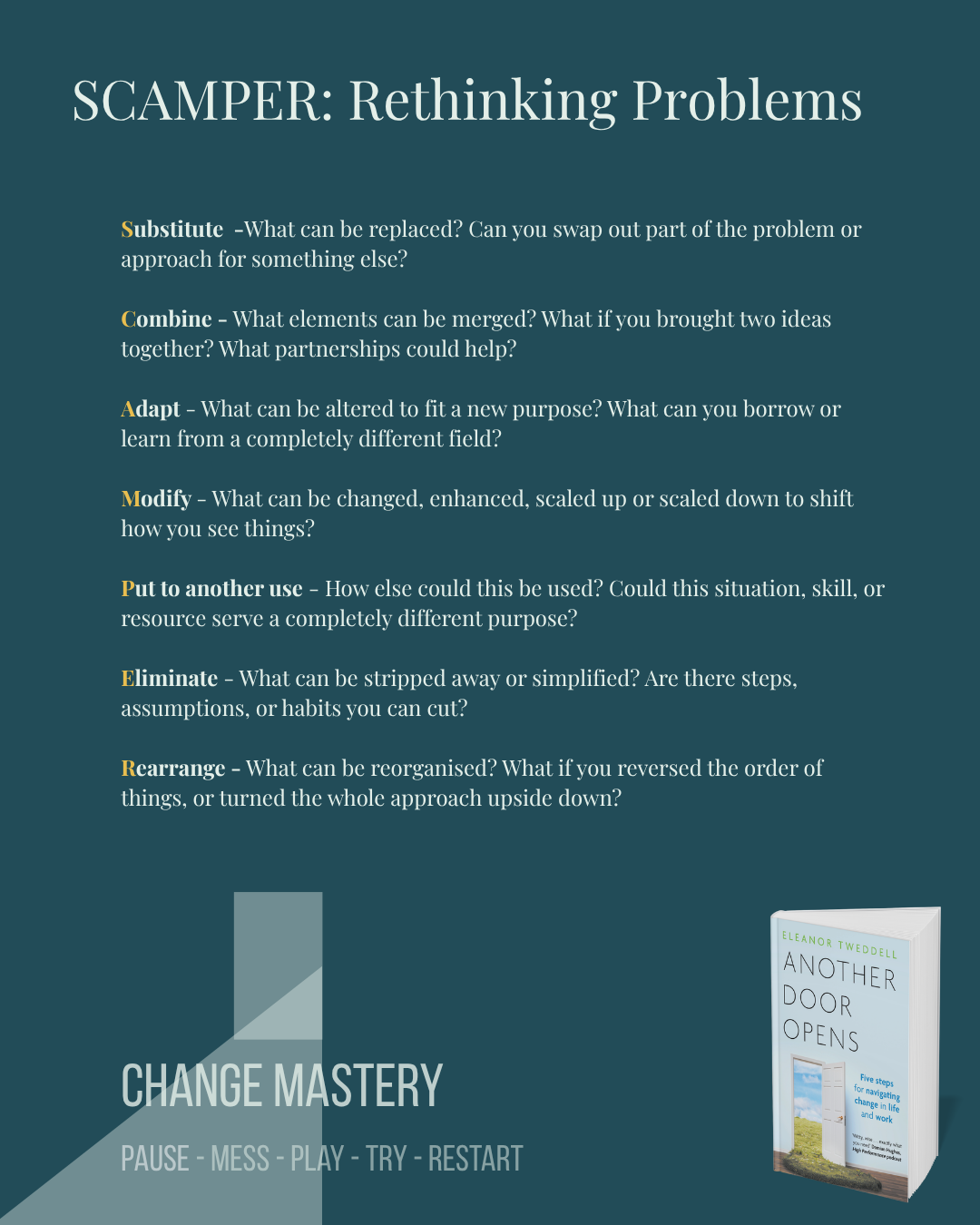
Substitute - What can be replaced? Can you swap out part of the problem or approach for something else?
Combine - What elements can be merged? What if you brought two ideas together? What partnerships could help?
Adapt - What can be altered to fit a new purpose? What can you borrow or learn from a completely different field?
Modify (or Magnify) - What can be changed, enhanced, scaled up or scaled down to shift how you see things?
Put to another use - How else could this be used? Could this situation, skill, or resource serve a completely different purpose?
Eliminate - What can be stripped away or simplified? Are there steps, assumptions, or habits you can cut?
Rearrange (or Reverse) - What can be reorganised? What if you reversed the order of things, or turned the whole approach upside down?
Each prompt unruffles the assumptions you didn’t even realise you were making.
How it’s been used
SCAMPER started in classrooms but it didn’t stay there. Product designers have used it to reimagine existing goods, think about how the humble Post-it Note was essentially a substitute for a bookmark combined with an adapted, low-tack adhesive. Ok, so I dont think the Post-It notes guys used SCAMPER itself, but the principles that sit behind it. Businesses use it in innovation workshops. Engineers use it to troubleshoot. Marketers use it to find new angles on old problems.
The beauty of it is its flexibility. It works on objects, systems, processes and, of course, life decisions. Because the same logic applies whether you’re redesigning a product or redesigning your next chapter.
Where SCAMPER fits in Change Mastery
I featured SCAMPER in the book Another Door Opens as one of the problem-solving tools in the Finding Solutions chapter, and it sits squarely in the Play space of Change Mastery, that open, curious, suspension-of-judgement zone where you’re not yet expected to have the answers. You’re just allowed to wander and wonder and explore.
In Play zone, we’re not making decisions. We’re generating ideas, testing assumptions, and seeing what surfaces. SCAMPER is perfect here because it doesn’t ask you to know anything, it just asks you to question everything.
And when you move into Try zone, when it’s time to actually take a step, SCAMPER can help you work out which step. Because sometimes what looks like a stuck decision is actually a question that hasn’t been asked yet. What if I eliminated one of the options entirely? What if I combined two approaches I’ve been treating as mutually exclusive? What if I rearranged the order I’m doing things in?
So when you are at a moment of feeling stuck, a crossroad of decisions to make, or needing to unruffle some fresh perspectives, SCAMPER will help you to rethink what you are thinking.
Playing with SCAMPER
The next time you feel your thinking looping, when you’re going round and round the same familiar options, when you are stuck - try pulling one SCAMPER question out and turning it on your situation.
Ask yourself: What could you substitute right now? What could you eliminate, without losing anything that actually matters?
Often, just one unexpected question is enough to kickstart momentum.
SCAMPER is one of several problem-solving frameworks featured in Another Door Opens a book for anyone navigating change and looking for fresh ways to think, create and find their next door.