From VUCA to BANI: Why the World feels harder to navigate
From VUCA to BANI: Why the World Feels Harder to Navigate (And What to Do About It)
It feels like the world has somehow shifted up a gear, that things aren't just changing faster, they're feeling genuinely harder to make sense of? The old frameworks we have relied on for decades are starting to feel a bit… inadequate.
Like good old VUCA. Still used in change training and thinking today but not feeling like it fits whats going on.
VUCA - Volatile, Uncertain, Complex, and Ambiguous, was originally coined by the US Army War College in response to the post-Cold War era. Initially designed to address geopolitical shifts, it found its way into the business world at the turn of the millennium. And it was useful. It gave organisations a shared language for the turbulence they were experiencing, and it shaped how leaders thought about strategy, risk, and change. It encouraged more agile ways of working, better scenario planning, and a mindset that accepted uncertainty as a feature of modern life rather than a bug to be fixed. So that all sounds good.
But then…
COVID came along and made VUCA seem out of touch, behind pace. Suddenly things collapsed overnight. Things we thought we knew for sure, wobbled, broke, crumbled. We all got lost, collectively and yet alone.
That's when a new way of thinking about this became useful.
Hello, BANI
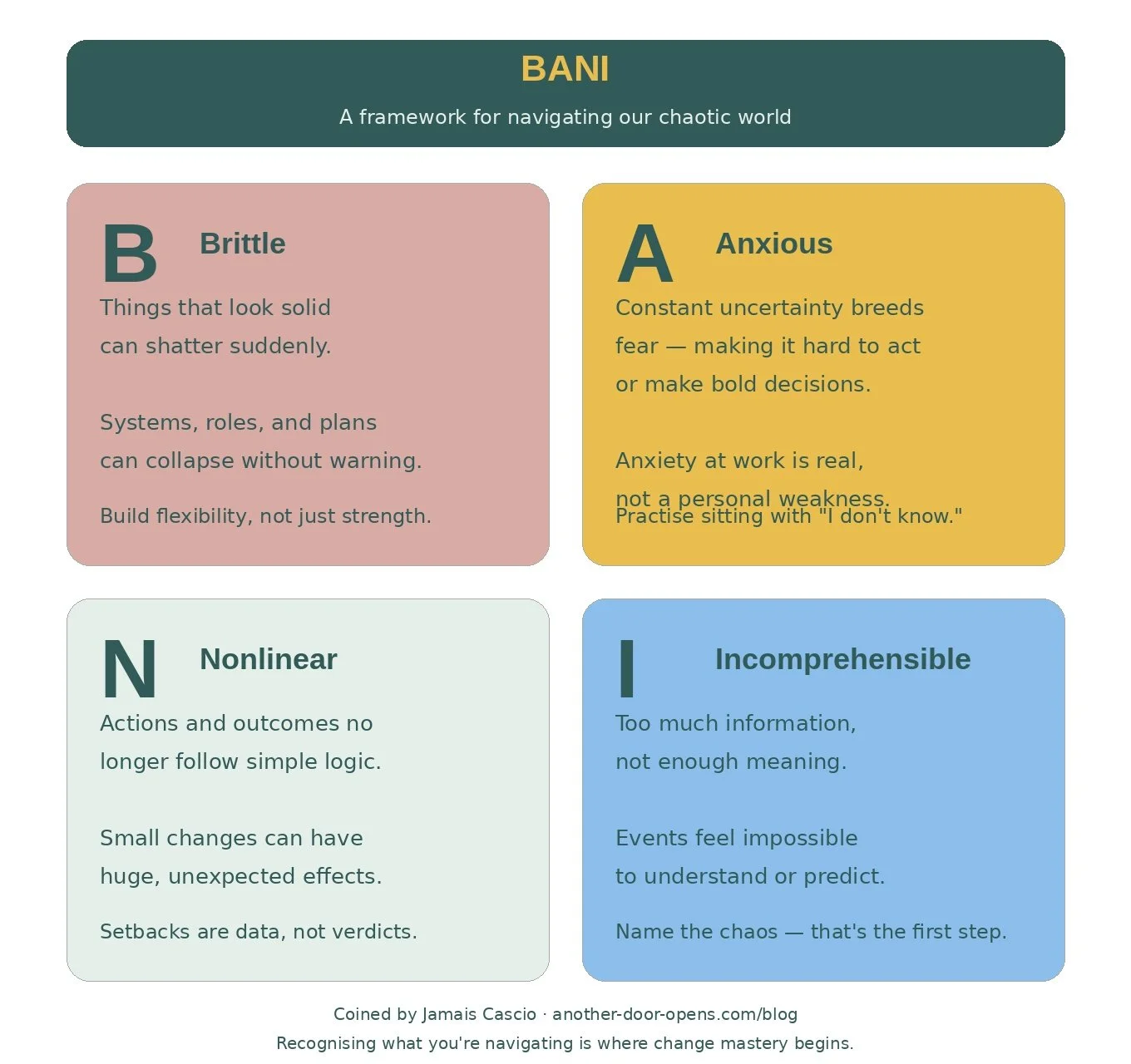
Futurist Jamais Cascio created BANI - Brittle, Anxious, Nonlinear, and Incomprehensible, as a way to better describe an increasingly chaotic world. He shared it in 2020 and it gained momentum. It captures what people are actually feeling when they show up to work in these BANi times.
Brittle - things that look solid can shatter suddenly. A restructure that happens with barely any warning, or a role that felt secure until it wasn't. Systems, though appearing solid, can collapse when faced with unforeseen disruptions. Products no longer needed, selling, being used. Maybe reflects fickle times?
Anxious - anxiety within BANI stems from the fear that something significant can unravel at any moment, and caused by constant movement and unknown.
Nonlinear - events dont follow a logical progression; small changes can have disproportionate consequences. You do everything "right" and still don't get the outcome you expected. Things are predictably unpredictable and messy.
Incomprehensible - we are overwhelmed by information without understanding what its all about. Too much noise, not enough bandwidth. We've all been there scrolling the news at 11pm wondering what on earth is going on.
What this means for you at work
So if you've been finding it hard to feel settled, focused, or confident at work lately, this is part of why. It's not a personal failing. Or that you are missing something. The environment itself has genuinely changed in character, not just in pace.
The BANI framework highlights the importance of understanding systemic fragilities and the psychological effects of fear in organisations. In plain English: your workplace (and life!) might be asking more of you emotionally and cognitively than it ever has before, while possibly giving you less certainty in return.
Read a more detailed article here »RSIS International
So what BANI is trying to do, to say, is normalise that life is no longer as it was, as we know, and we dont know what it will be.
Rather than a to-do list (because BANI is not a to-do list kind of world), here are a few questions to reflect on:
🔹 What are you anticipating? Anxiety thrives on "what ifs." How much of your mental energy is going on scenarios that haven't happened yet and might never? Noticing this is the first step to reclaiming some headspace and finding calm.
🔹 Can you sit with "I don't know"? In a BANI world, not everything is knowable and pretending otherwise is exhausting. Practising tolerance for uncertainty isn't weakness or giving up; it's a coping and reenergising mechanism.
🔹 Where are your anchors? When the external world is chaotic, what stays constant for you? Your values, your routines, your trusted people - these are your resilience infrastructure.
🔹 Are you treating every setback as a signal you're failing? Nonlinearity means unpredictable outcomes are inevitable. Reframing stumbles as information rather than verdict changes everything.
🔹 Who's in your corner? Perhaps (because we dont know) the organisations and people that will flourish are those that prioritise empathy, listening, and trust. The same goes for us individually. You don't have to navigate this alone.
The bigger picture
BANI is there to name what we're already living through. And as anyone who has navigated a significant change will tell you, naming something is powerful. It shifts you from "why do I feel so overwhelmed?" to "ah this is what an incomprehensible, nonlinear world actually feels like."
That shift, from confusion to recognition and acknowledgement, is where change mastery begins. Not having all the answers. Not being unaffected. But being able to say: I see what's happening here, and I can work with this.
The world has changed its character. The question is: how are you changing yours?