Most of us were never taught how to think through change. We were taught how to manage it — project plans, timelines, communication cascades, the works. But managing change and actually thinking your way through it are two very different things. One is a spreadsheet. The other is a skill.
That's the gap Change Mastery is built to close.
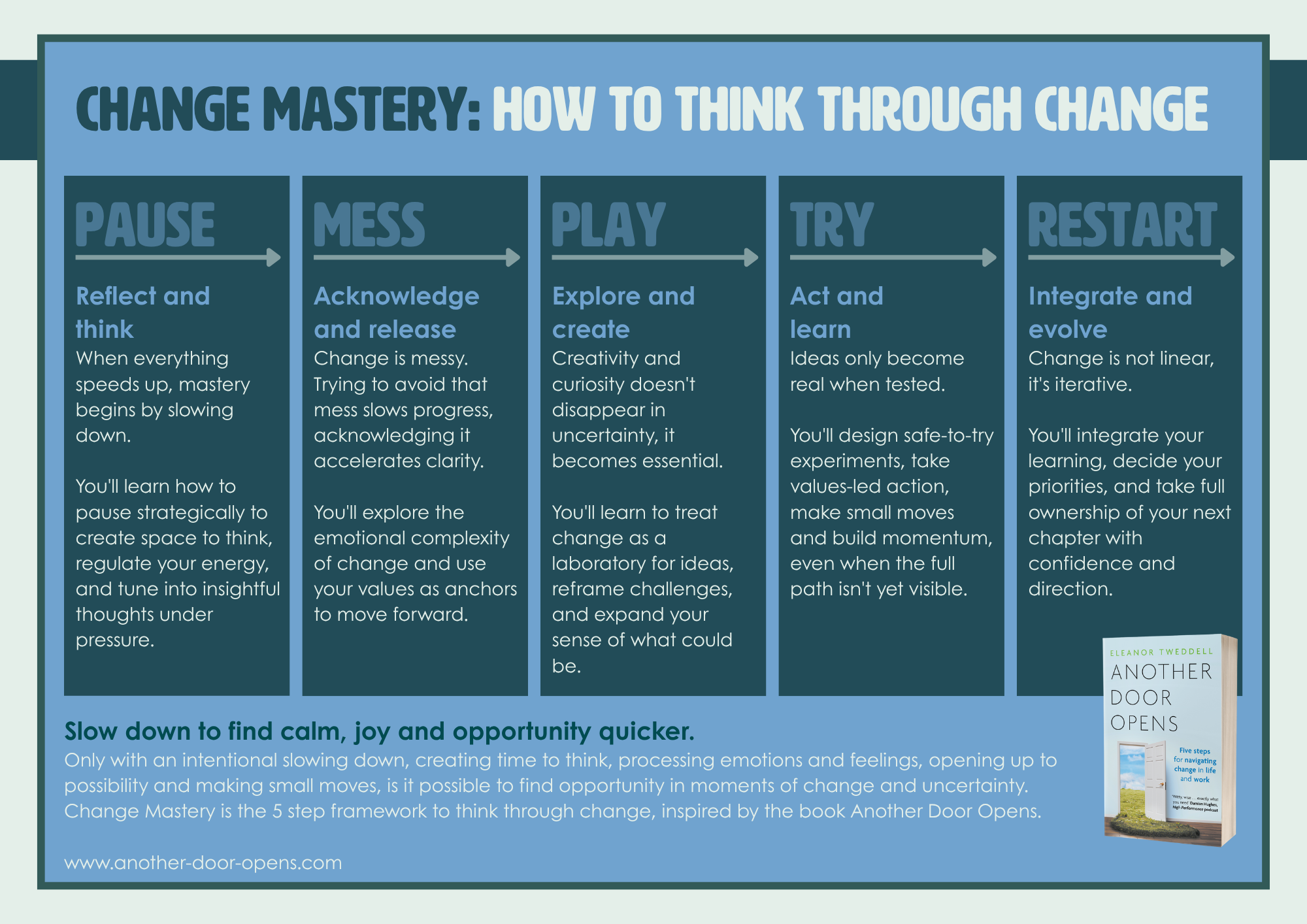
It's a five-step framework — Pause, Mess, Play, Try, Restart — that gives you a way to think, rather than a checklist to follow. And it applies whether you're navigating a restructure at work, a relationship ending, a move, a diagnosis, or simply the low hum of everything feeling like too much lately.
Slowing down to get there quicker
When everything speeds up, our instinct is to speed up with it. React faster, decide faster, fix it faster. But speed under pressure rarely produces good thinking, it produces the first thought that shows up, dressed up as the right one.
Change Mastery works the other way round. It says: slow down first. Not forever, not as an excuse to avoid the hard bit, just enough to find calm, clarity, and the opportunity that's usually hiding somewhere in the mess.
The five step thinking framework
Pause — reflect and think. When everything speeds up, mastery begins by slowing down. This is about creating space to think, regulating your energy, and tuning into the insightful thoughts that pressure tends to drown out. Not a retreat. A recalibration.
Mess — acknowledge and release. Change is messy, full stop. Trying to skip past that mess doesn't make you more efficient, it just delays you. Naming the emotional complexity of what's happening, and using your own values as an anchor, is what actually accelerates clarity.
Play — explore and create. Here's the bit people are most tempted to skip: creativity and curiosity don't switch off just because things are uncertain, they become essential. This is where change stops being a threat to survive and starts being a laboratory for ideas. Reframe the challenge. Expand what you think is possible. See what shows up when you're not trying to solve it yet.
Try — act and learn. Ideas only become real when they're tested. This step is about designing safe-to-try experiments, taking values-led action, and making small moves that build momentum, even when the whole path isn't visible yet. You don't need the full map. You need the next step.
Restart — integrate and evolve. Change isn't linear, and neither is this framework. Restart is where you integrate what you've learned, decide what actually matters now, and take ownership of your next chapter with a bit more confidence and direction than you started with.
Slow down to find calm, joy, and opportunity quicker. It sounds like a paradox, slower to get there faster, but it isn't. Rushing past the mess doesn't skip it; it just means you carry it with you, unprocessed, into whatever comes next. An intentional pause, room to feel what you're feeling, permission to play with possibility, and small moves tested along the way, that's what actually gets you through, and gets you through well.
Need time to think through change?
This framework is the baseline of a free 45-minute webinar, a chance to think through Pause, Mess, Play, Try, Restart properly, with space for your own questions and your own change, whatever shape it's currently taking.
[Sign up for the free webinar →]
And a great taster for the full 10 week experience launching on Maven. [See here for more information→]
Where are you in the five steps right now? Still deep in the Mess, or ready for the Restart? I'd love to hear.